
 Test Preparation
SAT Prep your students want to attend.
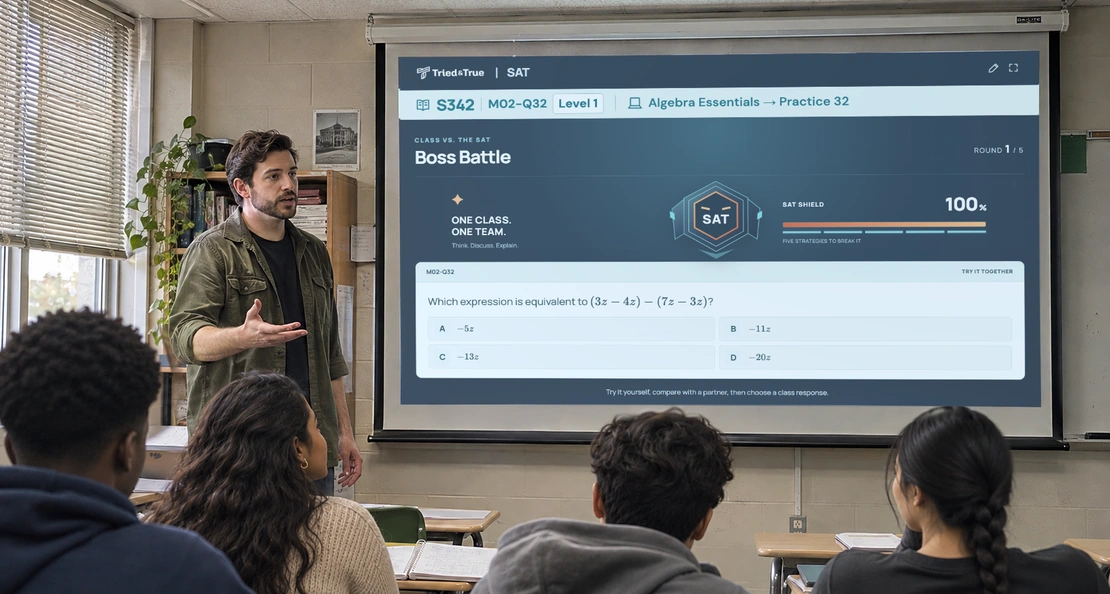
A Tried & True Teacher leads your class.
We’re educators ourselves. About one in every 100 applicants earns a place on our teaching team. We match your class with an instructor who comes prepared, on time, with a smile, or you don't pay.
Tried & True always has your back.
- On your campus
- Live on Zoom
available as curriculum/training for your staff
We provide the SAT curriculum and train your staff to teach it.
“Tried & True works with our first-generation students, and I’ve never seen them this excited about going to their SAT prep class.”
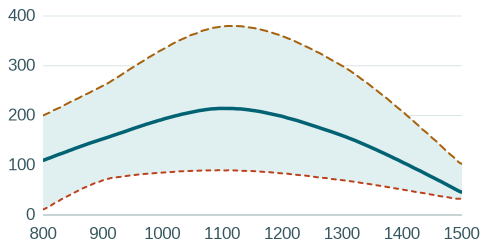
A track record of score improvements.
Instructional hours
-
WorkshopBuild confidence.1–2 hours
-
Boot CampDevelop strategies.2–12 hours
-
CourseMaster the exam.12–28 hours
Practice SAT points gained


Tried & True’s roots are in test prep.
Since 2003, founder Jonathan has helped students from all walks of life prepare for the SAT—from Hollywood families to tens of thousands of TRIO scholars. A multiple perfect scorer himself, he believes every student deserves the same expert preparation.
TRIO grant alignment
Choose your grant to see how SAT prep fits.
Upward Bound · Required service
Guided SAT instruction supports the college entrance exam preparation portion of this required service. 34 CFR § 645.11(a)(3)
Upward Bound Math & Science · Required service
Guided SAT instruction supports the college entrance exam preparation portion of this required service. 34 CFR § 645.11(a)(3)
Talent Search · Required service
Guided SAT instruction supports the college entrance exam preparation portion of this required service. 34 CFR § 643.4(a)(3)
Educational Opportunity Centers · Permissible service
Guided SAT practice helps participants prepare for a college entrance exam, a service Educational Opportunity Centers may provide. 34 CFR § 644.4(d)
Course details
Students build a repeatable approach to SAT questions through targeted instruction and guided practice. Choose Math, Reading & Writing, or both, with the scope set to fit the available hours.
Reading & Writing
- Punctuation Choose punctuation from sentence structure.
- Central Ideas State the main idea, then test the choices against the passage.
- Transitions Identify the relationship before choosing the transition.
- Logical Writing Place a description beside the person or thing it describes.
- Command of Evidence Use the evidence that actually supports the claim.
- Rhetorical Synthesis Select the notes that accomplish the stated goal.
- Verbs Match the verb to its subject and the sentence’s time frame.
- Pronouns Make each pronoun’s reference and grammatical job clear.
- Inferences Choose the conclusion supported by the given information.
- Cross-Text Analysis Compare the authors’ positions on the same issue.
- Words in Context Let the surrounding text determine the word’s meaning.
Math
- Graphing is Key Use graphing to find and interpret a solution.
- Algebra Essentials Choose an algebra rule, simplify carefully, and check the requested value.
- Lines Connect a line’s equation to its slope, intercept, and context.
- Polynomials Choose a polynomial form that exposes the quantity you need.
- Function Notation Treat function notation as an input-output instruction.
- Exponential Functions Identify the starting amount, growth factor, and interval.
- Percentages and Ratios Translate the comparison before calculating.
- Area and Volume Connect dimensions to perimeter, area, and volume.
- Unit Conversions Choose conversion factors that cancel the unwanted units.
- Geometry Use geometric relationships to build an equation.
Practice gains by starting score
Hear from a Talent Search partner
Casey Nelson, Florida State University Panama City Talent Search