

STEAM Escape Room
To solve the mystery in Boom Town, your students write Python, wire circuits, and make machines move.
A Tried & True Teacher leads your class.
We’re educators ourselves. About one in every 100 applicants earns a place on our teaching team. We match your class with an instructor who comes prepared, on time, with a smile, or you don't pay.
Tried & True always has your back.
- On your campus
available as curriculum/training for your staff
We provide the curriculum and train your staff to lead the escape room.
“They got to design and build and actually see the results of their code in real life.”
Watch why students came back 0:59
UC Davis Upward Bound Siskiyou students and their director describe how the story kept them coming back and what it was like to build the maze.

Step into the story.
Something is wrong in Boom Town’s computer science class. Your students join its high school heroes in a role-playing game. Solving each challenge takes them deeper into the mystery.

Build a puzzle another team can play.
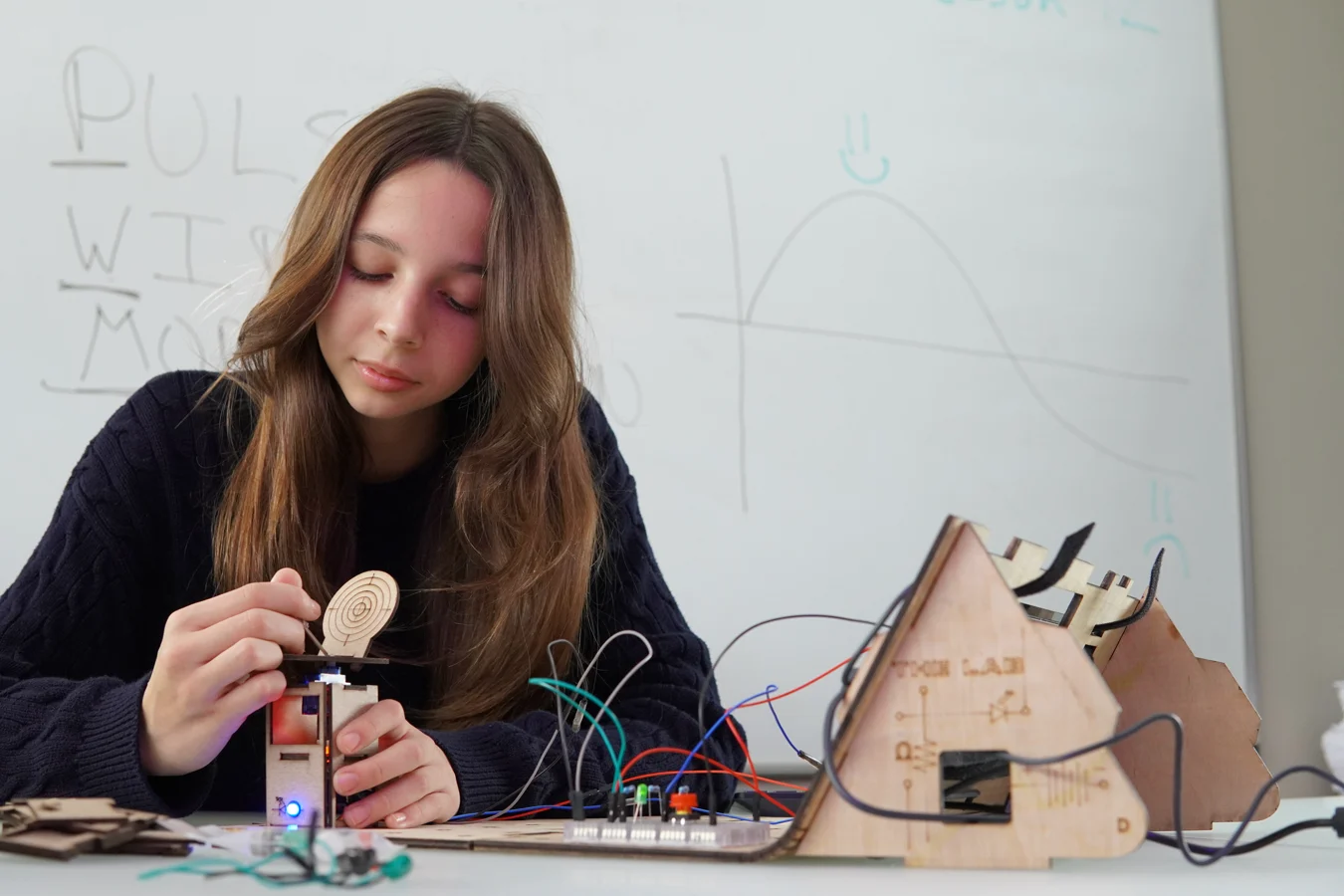
Students learn electrical engineering by wiring circuits and mechanical engineering by making puzzle pieces move. They practice computational thinking every time they break a problem into steps, test their code, and fix a clue that doesn’t work.
From a maze boot camp to a full semester.
12–60 instructional hours · 24–50 recommended
- 12 hoursMaze boot camp
Wire a circuit and code blinking clues for another team to follow.
- From 24 hoursBuild the escape game
Combine code, buttons, and lights in a challenge classmates can solve.
- From 42 hoursExplore the full kit
Work through all 18 core chapters, including sensors and servo motors.
- 60 hoursFull semester
Spread the adventure across a term, with time to playtest and refine the final games.
Can you escape all three rooms?
Guide the scout past three cameras. Block the color channels that make up each room’s light. When the camera feed goes dark, the scout can slip through. Each door limits how many switches you can use.
Choose a channel, then test your filter.
Need a clue?
A red light has just one active channel.
TRIO grant alignment
Choose your grant to see how the hands-on labs fit.
Upward Bound · Conditional required core curriculum
For Upward Bound projects funded for at least two years, selected investigations can contribute to the laboratory science core. Students test physical relationships, from electrical current to how sensors respond to light. 34 CFR § 645.11(b)(2)
Upward Bound Math & Science · Additional required service
As your students build circuits, write code and test escape-room puzzles, the hands-on electronics and computing chapters can contribute to your center’s intensive math and science instruction. 34 CFR § 645.14(a)(1)
Other connections to discuss with your TRIO partner
Upward Bound
- This applies if participating students would usually lack access to a hands-on electronics and computing program like this one. 34 CFR § 645.12(a)
- These lessons can form part of a summer bridge for high school graduates who intend to enroll in college that fall. 34 CFR § 645.13(a)(2)
Upward Bound Math & Science
- This applies if participating students would usually lack access to a hands-on electronics and computing program like this one. 34 CFR § 645.12(a)
- These lessons can serve as math or science coursework in a summer bridge for high school graduates who intend to enroll in college that fall. 34 CFR § 645.14(b)(1)
- This applies if students learn from a mathematician or scientist who researches and teaches at the applicant institution, or works in research or applied science at a hospital, government laboratory or other public or private agency. 34 CFR § 645.14(a)(2)
Talent Search
- This applies if participating students would usually lack access to a hands-on electronics and computing program like this one. 34 CFR § 643.4(b)(4)
Student Support Services
- This applies if participating students would usually lack access to a hands-on electronics and computing program like this one. 34 CFR § 646.4(b)(3)
Course details
Students typically share a kit in pairs, with one computer per kit. Your program length determines the chapter sequence, which can include an optional code-refactoring extension.
- Explore the Boom Town story and classroom materials
- See classroom projects in the curriculum guide (PDF)
- Next Generation Science Standards alignment (PDF)
- Breadboards Describe breadboard features and trace how current flows in a simple circuit.
- GL!TCH Kit Assembly Identify core hardware and demonstrate the kit setup and cleanup routine.
- Coding Use a test case to check and debug a short program.
- Series Circuits Build and label a working LED series circuit.
- Parallel Circuits Compare how LEDs behave in series and parallel circuits.
- Coding & Circuits Modify a short program with a loop and test its effect on the circuit.
- Buttons & Switches Use a button signal with an if-else decision in code.
- Escape Room Maze Build and test a team-designed maze that uses timed LED signals.
- RGB LEDs Program an RGB LED to change color and explain how the color is produced.
- Code Refactoring Revise game code so it is easier to read and explain what changed.
- Light-Dependent Resistors Test whether a light sensor makes a night-light prototype respond as intended.
- Lasers Describe how the light sensor responds to a laser in a supervised kit activity.
- Laser Tripwires Build and test a light-based puzzle signal and use it to transmit a short message.
- For Loops Use a loop and a sequence to simplify code for a repeated task.
- Pulse-Width Modulation Model pulse-width modulation and use a programmed input to control an LED output.
- Intro to Servos Explain how changing a program affects a servo’s movement.
- Servo Motors Improve a program so a servo moves smoothly and coordinates with an LED.
- Touch Sensor Compare a capacitive touch signal with a previously tested sensor signal.
- Final Escape Room Game Build, test and improve an escape-room challenge using the inputs and outputs already taught.